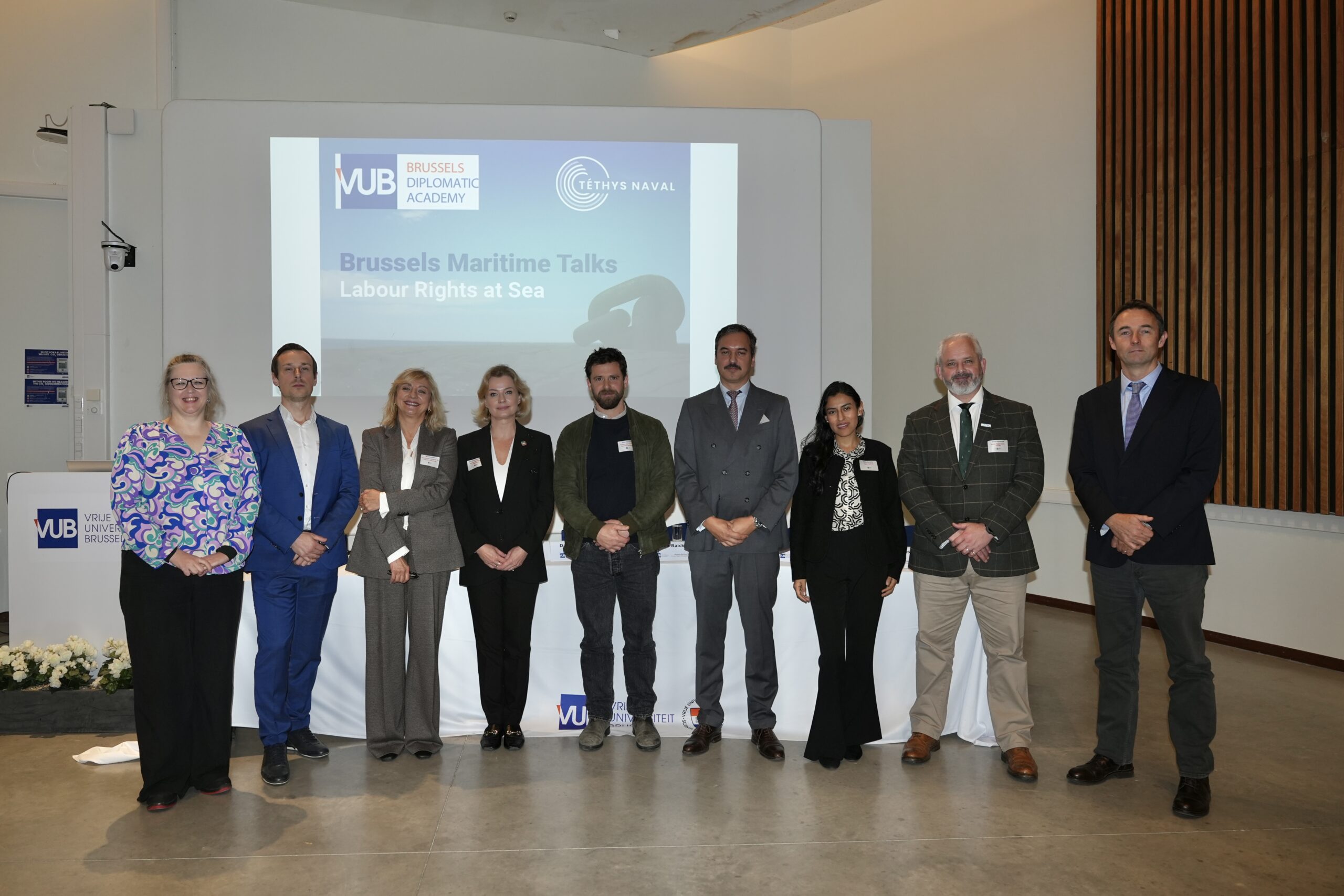
On 4 November 2025, the Brussels Diplomatic Academy (BDA), in partnership with Téthys Naval, hosted the inaugural Brussels Maritime Talk (BMT) at the Vrije Universiteit Brussel. Entitled “Labour at Sea: A Human Rights Perspective,” the event marked an important step in maritime dialogue — placing the realities of life and labour at sea within the frame of international human rights.
Although ninety percent of global trade is carried by sea, the human dimension of this vast system remains largely invisible. Seafarers, fishers and offshore workers sustain the world’s economy, yet their experiences — which involve exploitation, abandonment or abuse — rarely make the headlines. The BMT brings these people behind the statistics into policy conversations and connects law, commerce and humanitarian values in one space.
Confronting the Unspoken
The BMT was a working dialogue among actors who rarely share the same table — international organisations, shipowners, NGOs, regulators, academics, diplomats and practitioners from the deck to the boardroom.
From the outset, contributors spoke of practices at sea which, if they occurred on land, would dominate the news and prompt immediate action. Instead, distance, jurisdictional complexity and fragmented maritime governance often obscure responsibility.
According to Philipp Hermes, initiator of the Brussels Maritime Talks “[t]he discussions showed that human rights at sea are not an abstract principle, but a test of how effectively the global community applies its values when no one is watching.”
A Tapestry of Expertise
Foundational perspectives came from representatives of the International Tribunal for the Law of the Sea (ITLOS), the International Maritime Organization (IMO) and the International Labour Organization (ILO), whose mandates define the legal scaffolding of maritime governance. Their interventions framed the discussion on how international law can — and sometimes fails to — protect those it was designed to serve.
Practitioner accounts followed from Koninklijk Belgisch Zeemanscollege (KBZ CRMB), Human Rights at Sea (HRAS), Hapag-Lloyd AG, Médecins Sans Frontières (MSF), the International Code of Conduct Association (ICoCA) and Téthys Naval. Each illustrated a different facet of maritime life — from shipping and port welfare to humanitarian rescue, security governance and crew representation.
This diversity of voices proved essential. Legal analysis alone cannot capture the lived reality of the engine room or the bridge, nor can operational experience alone resolve questions of accountability. By weaving these perspectives together, the BMT created a rare ecosystem of shared understanding.
Where Policy Meets Practice
At the heart of the event was a two-hour dialogue moderated by the BDA, where speakers and participants distilled key themes to guide future action:
- Accountability at sea — how overlapping jurisdictions and weak enforcement impede justice for exploited or abandoned crews.
- The economics of neglect — how cost pressures within supply chains can lead to unsafe working conditions and rights violations.
- Transparency and data — the need for shared reporting frameworks connecting public and private actors.
- Education and awareness — ensuring that policymakers and the public understand the realities of maritime labour.
One insight resonated throughout: the practitioner’s perspective must anchor policy. Decisions made far from the waterline have direct consequences for those who live and work at sea. Practitioner involvement restores both accountability and humanity to maritime governance.
A New Standard for Maritime Collaboration
Participants described the Talk as a ground-breaking, cross-silo initiative that demonstrated the power of collaboration beyond traditional boundaries. Representatives from law enforcement, trade unions, the European Commission, national ministries and diplomatic missions joined counterparts from civil society and industry in a spirit of constructive engagement.
The KBZ CRMB observed that such gatherings should become a recurring fixture in the maritime calendar — a platform for shared reflection and sustained cooperation. The sentiment was widely echoed: the complexity of modern maritime challenges demands precisely this kind of interdisciplinary dialogue.
Continuing the Momentum
For Téthys Naval and the Brussels Diplomatic Academy, the success of the first BMT affirmed a shared conviction — that maritime governance must evolve in step with moral responsibility. Future editions will build on the themes identified, exploring digitalisation, sustainability and crew welfare, while preserving the human-centred ethos that defined the inaugural event.
Films and testimonies shown during the Talk offered unfiltered, often violent, glimpses into life at sea — vivid reminders that behind every shipment and trade route stand individuals who need their rights and dignity to be upheld.
The message from Brussels is clear: the oceans connect us all, and so should the lives of those who work upon them. We all benefit from their labour, protecting their rights is the least we can do.
Photo credit Ana Martins Photography
Photo l-r Prof. Dr. Cailin C E Mackenzie, BDA, Patrick Boyens, President of KBZ-CRMB, Judge Ida Caracciolo, ITLOS, Dorota Lost-Sieminska, Director, Legal Affairs and External Relations Division, IMO, Julien Raickman, MSF, Operational Center Brussels, Philipp Hermes, Director, Téthys Naval, Diana Sanabria, Hapag-Lloyd AG, David Hammond, Executive Director, HRAS, Jamie Williamson, Executive Director, International Code of Conduct Association ICoCA.